
“We’ve forgotten how to add secrets.”
Alex Mann leads the platform team at Apollo GraphQL, and he said this while we were building our QCon talk. Engineers who launched services and wired up production secrets a year ago now wander into the platform team’s inbox channel when the agent can’t do it for them. The same engineers now fix memory leaks in hours that used to take months.
Both are true at the same company, in the same quarter.
Platform leaders I’ve talked with this year tell versions of the same story. A brand new codebase, a few weeks old and millions of lines long, written by one person and about to carry a load-bearing feature. An engineer who burned through the team’s monthly token budget because a new model came out, the tooling picked it up, and nothing sat between the engineer and the bill. An agent that got hold of an engineer’s GitHub key and merged the PR that caused a high-severity outage. The engineer never approved it.
These stories have the same shape. The platform underneath was built for someone else.
Three years ago, on the QCon SF stage, I argued that a good platform delivers acceleration, autonomy and accountability. These pillars still hold. AI has rewritten what each one requires, and the platform team’s job along with it.
Built for someone else
We built platforms that are very good at vending. Daniel Bryant, our QCon track host, calls it the vending machine. You ask, it dispenses. Managed databases, service templates, test harnesses, each one compliant, fleet-managed and disposable. And we built them for product engineers.
The platform now serves different kinds of users. Everyone builds now: PMs, designers, researchers, support engineers, marketing, even legal. And we have agents, acting on someone’s behalf. Unlike people, agents don’t wait to be onboarded.
So the question every platform team faces is whom to slow down and whom to let through. And does the platform team spend its time guarding the gate, or building the foundations that let you open it?
Who carries the trust
We designed security and reliability for people we’d hired and onboarded. Even our zero trust posture was built for humans. A vending machine doesn’t care who you are. Passport control does, because trust is part of the platform itself. How you design your platform depends on how it is consumed, with a human in the loop or without. And without a human, who carries the trust?
I think of it as the same autonomy spectrum I used for metrics, with three stages.
- Humans review everything. Agents write, and a person sees every change before it moves. The reviewer carries the trust.
- Agents run with gates. Agents write code, test, open the PR and maybe fix their own build. Humans approve at the gates. The gate carries the trust.
- Agents ship, and you sample after. Nobody sees every change, so the trust lives in the grant, the set of things the agent was allowed to do in the first place.
What the platform team builds and supports depends on where your organization sits today. Most orgs I talk with moved from shadow AI tools to a sanctioned gateway this year, with trust still resting with the humans reviewing each change. That’s stage 1.
Moving along these stages isn’t all or nothing. Each stage scales how far the impact reaches, from one person to a workflow to the whole org.
At Apollo, I used the 5 Cs from my Pilots to Production post (clarity, context, coupling, controls and confidence) as guiding principles to move us along the spectrum.
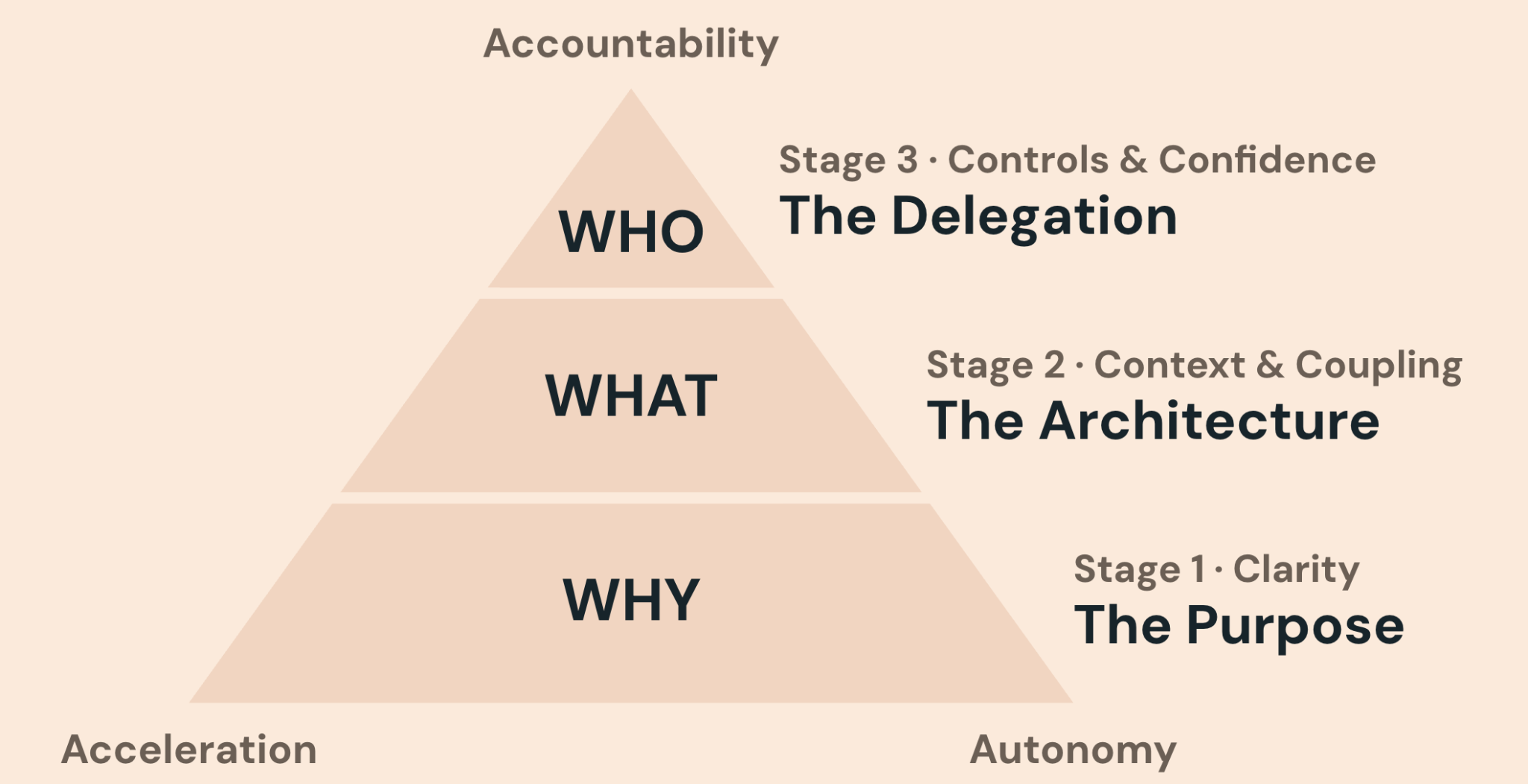
Stage 1 · The reviewer: know your customer
Stage 1 is about purpose, so its binding constraint is clarity. Before a border lets anyone through, it learns who they are and why they’re here. Who are your customers now, agents and non-engineers included? Whom do you want to onboard first? Which use cases are narrow enough to trust?
The more tuned an agent is to a specific problem, the more often it succeeds. Monica Bajaj, SVP of Engineering at Okta, put it best on a GraphQL Summit 2025 panel: “Purpose is going to define the footprint of the permissions.” The clarity you get in stage 1 sizes the grant in stage 3.
At Apollo, the platform team built four things in this stage.
Sanctioned tools. We wrapped coding agents in deterministic scaffolding and pointed them at well-understood use cases. We moved from Cursor to Claude Code to Codex and back to Claude Code as the models changed.
A place to share. Early adopters posted wins and misses in one Slack channel, so everyone learned from the same experiments.
Maps. That channel showed us where AI created leverage and where it created overhead. We started with mapping engineering workflows, like debugging and prototyping, to unlock early wins.
Enablement. A small pod inside the platform, focused on learning how to build with AI.
Clarity shows up in the brief. Alex watched the same agent get two different asks. Inside our monorepo, ask it to spin up a new service, vending machine style, and it follows the paved road to production, because everything it needs is right there. Ask it to “just make it work” and it does its own thing. We started seeing teams with their own stacks, their own deployment pipelines and their own cloud projects, then asking the platform team why production didn’t work. Rare work made it worse. Setting up a production secret for a third-party vendor happens a few times a year. Nobody remembers how, so they ask the agent, and the agent takes whatever path it can see.
Same agent, same people. Only the ask changed.
Now multiply that by every team. As I wrote in Judgment Is the New Bottleneck, code got cheap, and the volume landed on review, CI and test infrastructure that weren’t built for it. DORA’s 2025 research found that AI amplifies whatever is already in your organization, and that breaks the human reviewer.
That load-bearing repo from the start is where this ends up. Nobody is reviewing it. Teams start thrashing. Individual acceleration doesn’t yet add up to org-wide impact.
Looking back, I’d have spent more of stage 1 unblocking code review, and been deliberate sooner about which human review policies to adapt for agents.
Stage 2 · The gate: know your contracts
To keep up with agent throughput, trust has to move to the gates. Stage 2 is about architecture, and its binding constraints are context and coupling. The same agents that write more than we can review can also read years of data we never had time for.
The vending machine asks one question. Can you have this? Provisioning was never the hard part, and agents will happily provision all day. Passport control asks what your agent needs for its purpose, and how it can get it. Your contracts answer both. They make context findable, with data, formats and APIs an agent can rely on. And they keep you loosely coupled to vendors, so swapping a model is a simple change in one place.
The platform team built four things here.
Collect. Logs, dumps and telemetry, in one place agents can find them.
Standardize. Tight coupling where we wanted to centralize: data formats, paved roads, and lifecycle contracts for how a capability is created, versioned and retired. Years of platform API investment paid off here.
Expose. Capabilities agents call through an internal MCP server, so agents don’t rebuild what already exists.
Harness. Loose coupling to model vendors, through one gateway. Remember the blown token budget? A gateway gives you one place to decide which models, what budget and who approves a switch. You can route work by model performance and tune token costs from agent logs. The model proposes, and the harness enforces. Give the gateway a dedicated owner. It stops being a side quest.
Stage 2 unlocks acceleration across a workflow and bounded autonomy for agents, with accountability moving to the gate. Alex’s team has two stories from this stage that I love.
Three standards became one. We had roughly three ways to build a GraphQL server. Agents wrote hundreds of unit tests to pin down each service’s contract, then iterated overnight on one instruction: replace A with B, and don’t touch the tests. The result was one chassis, a simpler deployment story and less to carry. This playbook also helped the team move a critical Node.js service, one we’d spun out of the Kotlin monorepo the year before, back into Kotlin and into the monorepo, with zero downtime. The key unlock came through new production smoke tests. A year earlier, nobody would have greenlit that risk.
Crash dumps nobody had time to read. Years ago, the team built Sweep, a small daemonset that sweeps JVM heap dumps from every Kubernetes node into a storage bucket. For years we read those dumps only in a handful of incidents, when the one person who could decipher them was on the call, and more than once someone proposed killing it. In March, an agent’s analysis of a dump was laughable. By July, it got close on the first try. By October, agents were reading the dumps on every out-of-memory crash, several times a week. By the day before our talk, Sweep had gone quiet, because the team had fixed every known crash of that kind.
One leak shows why that matters. A cron service kept running out of memory on Sundays, but only after it had gone more than two days without a deploy. An upstream library bump was leaking a whole client on every job run. The fix, one shared client, merged that afternoon. The agent checked its own answer against our telemetry. A human alone would have had a much harder time spotting that pattern.
The models got better. It worked because the dumps were already being collected.
Debugging faster doesn’t make shipping safer, though.
Stage 3 · The grant: know your agent
In stage 3, agents ship and you sample after. This stage is about delegation, and its binding constraints are controls and confidence.
Remember the PR nobody approved? The agent had a key. It never had a grant. Two questions carry this stage. Who let it through? And who saw what it did? To answer them, you codify trust in the grant itself.
The platform team builds four things here too.
Decide your policy. The more freedom you give agents, the more you need deterministic policies with enforcement, so you can choose when an agent is blocked from proceeding.
Reuse your foundations. You have years of tests, telemetry, identity and access work. Codify them and put them in front of the agents. At Apollo, ours came out of a reliability turnaround years earlier. Nobody built them for agents. What’s good for humans is good for agents.
Scope every grant. Tie every agent to a human. Give it a grant for a purpose and a time, and make sure you can take it back.
Sample. The hardest failures don’t throw errors. The work comes back and it isn’t quite right. We learned this when we rewrote our router’s query planner, where a new plan could run cleanly and still return the wrong response shape. So we shadow-tested, running old and new side by side and comparing response shapes before anything shipped. Agent work needs the same checks and evals against a known-correct answer.
Here’s what that looks like in Apollo’s deploy path. A year ago, a healthy service and a human-merged promotion PR were the only gates to production. Today the promotion PR runs policy checks, and the biggest one asks whether the service’s monitors are healthy. Staging already ran as close to production as we could make it, minus scale, so the thousands of monitors anyone at the company could already write became tests in front of production. Another check holds a promotion if something else deployed in the last ten minutes, so production can settle first. Any check can be overridden with one label, tracked in Git, so a roll-forward fix never waits.
That made a narrow grant possible. Evergreen, the team’s dependency workflow, waits three days after a new release, then lets the Renovate PR auto-merge if CI passes and ride the same gates to production. If CI fails, an agent adds tests to expose the failure. The grant is to upgrade dependencies, and nothing more.
The platform team owns policy and agent identity as products, and brokers code ownership across the org once anyone’s agents can ship.
Passport control
That’s passport control, and it has five parts.
- Passport. An identity tied to a human, so an agent is never a ghost.
- Visa. A scoped grant, for a purpose and for a length of time.
- Officer. Deterministic policy at the gate.
- Stamps. An audit trail of every action.
- Cancellation. Revocation that works mid-session.
Evergreen has a visa for upgrades and nothing else. That’s the clarity from stage 1, sizing the grant in stage 3. Who let it through? The officer. Who saw what it did? The stamps. Neither answer is a person.
What’s unsolved is identity. Most internal agents still borrow a human’s credentials. Scoped, revocable access for agents is being built across the industry, and it’s early. Looking back, I’d start on agent identity sooner.
What changed, and what didn’t
At QCon, Alex shared where Apollo stands ten months in. From January to October, after Apollo rolled out AI across the org, PRs shipped to production in the control-plane monorepo roughly tripled, from about 54 a week to more than 150. Incidents held flat at about one a week, mostly low severity and not customer-facing. Leaks and crashes that used to take months to chase now get fixed in hours. Speed and reliability stop trading off once confidence is automated.
A few things are still open. They’re about the impact on people, organization design and collaboration. Engineers are burning out reviewing large agent PRs, and the skills that fade with agents are the ones from our opening, the engineers who forgot how to add a secret. Every 3x, what worked before stops working. Speed came from the platform. Keeping judgment sharp is a management job, and it’s my next post.
Token spend keeps rising, and the conversation has moved from adoption to proving value. And that raises the hardest question. Does any of it matter to a customer? Nobody has nailed measuring AI’s return. We’ve always measured proxies like PRs shipped, time to production and tickets closed. Where Apollo can prove it, it shows up in reliability, performance and support, with fewer crashes, faster on-call pages and a support queue shrinking faster than it grows.
As Alex put it, agents gave the team speed, but what they now need is velocity. Velocity has a direction, and more PRs alone don’t give you one.
Five questions for Monday
- Where did your bottleneck move once agents started writing more of your code?
- What does your agent need, and how can it get it?
- Who let it through?
- Who saw what it did, and can you take it back?
- If engineering were twice as fast in the next quarter, what would your best customer notice first?
If you only do one thing this quarter, pick one agent workflow, write its grant down in a sentence, and make sure you can revoke it.
The platform was always the point of leverage. Now it’s also the broker for trust and velocity.
The rule I’d leave you with: teams grant more when they can take it back. What’s the first grant you’d be willing to write down?
Thanks to Alex Mann, who co-presented this talk at QCon SF and whose team did the work in the Apollo stories above. References:
- Smruti Patel, “The Three As of Building A+ Platforms: Acceleration, Autonomy, and Accountability,” QCon SF 2023 / InfoQ
- Daniel Bryant, “Platform Engineering for Software Developers, Architects, and the Rest of Us,” GOTO Copenhagen 2025
- GraphQL Summit 2025 panel, “Shipping Agentic Experiences: Going Beyond Pilots to Production,” with Angie Jones, Monica Bajaj and Kewei Qu
- DORA, State of AI-assisted Software Development, 2025